The Rime of the Ancient Mariner by Coleridge. A poem of fall and redemption. One of the Gems of English Literature

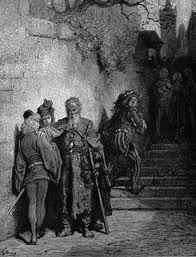
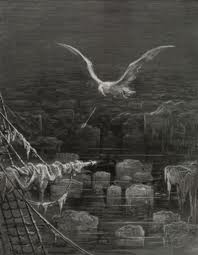
Illustrations by Gustave Dore to The Rime of The Ancient Mariner.
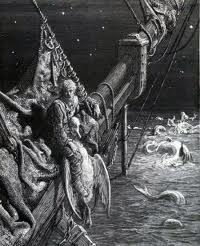
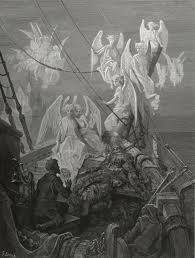
Orson Welles brings the story to life here.
An appreciation of a truly great poem.
"It is an ancient Mariner,
And he stoppeth one of three.
"By thy long grey beard and glittering eye,
Now wherefore stopp'st thou me?"
With these four lines, telling you of how a guest on his way to a wedding is accosted by an aged seaman, one of the most famous poems written in the English language begins.
The poem "The Rime of The Ancient Mariner" by Samuel Taylor Coleridge grabs the reader from the very start. Of all the poetry that has ever been written this masterpiece must be one of the most compelling. The lesson of redemption, which is contained within this story of the seaman who kills the innocent albatross, resonates deeply within any person who reads the poem. If any piece of verse can be said to be truly inspired, this is it.
The poem was written at a time, the early nineteenth century, when people were fascinated in reading the accounts of the voyages of Captain Cook, and those of The Bounty. It perfectly describes the feelings of isolation that must sometimes have been felt by those pioneering mariners, when they were becalmed in the middle of a vast ocean in a small wooden ship.
The really great thing about "The Rime of the Ancient Mariner" is it's sheer readability, and the cracking pace of the dramatic story that drags you into the world of the sailor on his "painted ship upon a painted ocean"
The descriptions of the Polar Regions, where the ship strays to, have not been bettered in any portrayal since.
"And through the drifts the snowy clifts
Did send a dismal sheen:
Nor shapes of men nor beasts we ken--
The ice was all between.
The ice was here, the ice was there,
The ice was all around:
It cracked and growled, and roared and howled,
Like noises in a swound!"
It is while the ship is leaving this world of icy magnificence that the crew are joined by an albatross that accompanies them on their journey through the unending oceans. There was a belief then, and there probably still is now, among sailors that the albatross is the friend of mariners. It was considered to be great bad fortune to kill one. But for some weird reason, not gone into by Coleridge, the ancient mariner shoots the bird with his crossbow.
This is where all the problems commence.
The ship became becalmed in the middle of the ocean. The sun beat down on the crew, and they all cursed the mariner for killing the albatross. The sheer horror of their situation is portrayed in these memorable lines.
"All in a hot and copper sky,
The bloody Sun, at noon,
Right up above the mast did stand,
No bigger than the Moon.
Day after day, day after day,
We stuck, nor breath nor motion;
As idle as a painted ship
Upon a painted ocean.
Water, water, every where,
And all the boards did shrink;
Water, water, every where,
Nor any drop to drink."
The crew hung the dead albatross around the neck of the killer, as a constant reminder of the sin that he had committed. He was unable to remove his grisly trophy.
The horror reaches a ghastly climax when a dreadful ship carrying "Death" comes to claim the sailors, all except for the ancient mariner. They all die with a curse on their lips, for their fellow, that has brought them to this end.
The unfortunate survivor can neither die, nor pray for forgiveness. The bodies of all his companions fix him permanently with unforgiving stares. The sense of desolation that must be felt by someone almost maddened by guilt, and loneliness is perfectly described in the lines that follow.
When the ancient mariner blesses the beauty and grace of a vision of sea serpents, his path to forgiveness begins, and the albatross finally falls from his neck.
"O happy living things! no tongue
Their beauty might declare:
A spring of love gushed from my heart,
And I blessed them unaware:
Sure my kind saint took pity on me,
And I blessed them unaware.
The self same moment I could pray;
And from my neck so free
The Albatross fell off, and sank
Like lead into the sea."
It is then that, according to the poem, The Divine starts to take a hand in the working of salvation for our ancient mariner. The dead crew are reanimated, and they start to work on the sails and the rudder, to drive the ship forward. At the end of each day, the blessed spirits, which had inhabited the bodies of the dead seamen, gather by the mast to sing hymns to God.
There then follows a dialogue between a spirit that had been following the ship since it's sojourn in the icy regions, and another that probably represented the voice of God. The second spirit decides that the mariner has repented, and should be forgiven.
Eventually the ship reaches the native country of the ancient mariner, and he can see the church on the hill, where he used to worship. He thanks God for his deliverance.
When the pilot rows out to escort the ship into port, it sinks like a stone, but the mariner is rescued. He confesses his sins to a blessed hermit, and is finally forgiven.
But he is fated ever after to retell his story to certain people, and to convey this message to all who might hear him.
"He prayeth best, who loveth best
All things both great and small;
For the dear God who loveth us
He made and loveth all."
I will end my appreciation of "The Rime of The Ancient Mariner" by Samuel Taylor Coleridge by quoting the verse that of all lines in poetry is perhaps the most graphic. I can never get these out of my memory, and I love them with an appalled fascination. I try not to remember them when I am alone at night in the dark.
"Like one that on a lonesome road
Doth walk in fear and dread,
And having once turned round walks on,
And turns no more his head;
Because he knows, a frightful fiend
Doth close behind him tread."
It truly is a brilliant poem. If you do nothing else today, find it, and read it.
The truth is in here

Discover some hidden history
There is a continuing fascination with the Illuminati and their all pervasive influence on world affairs.
There was an organisation called the Illuminati, which was founded in Bavaria in the eighteenth century. This is not the sinister organisation that aims to gain ruler ship over the world.
Only very few people can reveal the true facts about this sinister “society above society”. I am one of those with full knowledge. No doubt you are wondering how deep my insight goes.
To find out read my latest e-book The Zombie, the Cat and Barack Obama. It tells the story of the brilliant pianist, but loathsome zombie, Julian Faversham and his attempted assassination of Barack Obama.
It contains information on the history and power of the Illuminati that is not detailed anywhere else.
There is also some fascinating, but very embarrassing, information about the ancestry of Barack Obama.
Osama bin Laden was not killed in the way we have been told either. Read the true account of his demise here.
There is a royal connection here also, (or at least a Buckingham Palace connection).
Read the reviews and
sample it for FREE at AMAZON.
United States.